
The Varroa Mite
After spending many years carefully reviewing all the scientific evidence, reading articles, forums and blogs about them, discussing it with other bee keepers to form a considered and mature opinion on the subject, I am of the opinion that there can be little doubt that Varroa are bastards.
Real bastards like utterly useless nasty bastards that have nothing going for them and deserve to be repeatedly punched in the face.
Admittedly they are only a couple of millimetres big and don't actually have a face but you get what I mean.
Varroa is a small reddish mite that originated in Asia. However in our ceaseless demand to consume what we want when we want it, not only do we import things from all over the world, we also import diseases from all over the world.
It arrived in Japan and Eastern Europe in the 1960's, South America in the 1970's, Europe in the 1980's, America in 1987 and England in 1992
Its now found everywhere in the world except Australia [its in New Zealand so this won't last] and it is considered to be one of the major causes of bee decline.
Its full Latin name is
Varroa Destructor and anything with
Destructor in its name gives you a good idea of what you're up against and it isn't going to be good.
Something with a name like
Varroa Fluffykins or
Varroa Mostly Harmless wouldn't have quite the same impact as something called
Varroa Destructor.The female mites enters an open cell in a bee hive, just before the cell is about to be capped where it will hide in the brood food situated under the larva. There it will wait for 2-3 days, breathing from a respiratory organ known as a peritreme. Once the food has been consumed by the larva, the female mite will begin reproduction inside the sealed cell, laying her first egg (generally male) and later, in intervals of around 1-2 days, the female will continue to lay up to seven eggs which are usually female mites. These hatch into immature mites of which only two to three reach adult stages.
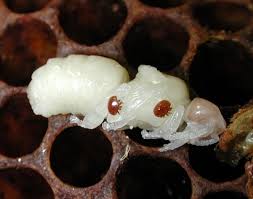
While inside the cell, the mites will feed on the developing pupae, transmitting viruses which can shorten the life span and stunt the pupa’s development. After 21 days, the worker bee emerges (24 for male drones) along with any surviving mites which attaching themselves to the bee’s dorsum until they reach a new open cell with a larva in it.
 |
| Varroa mite attached to larvae |
 |
| Varroa mite on pupae |
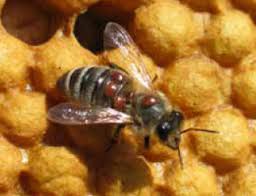 |
| Varroa mites on adult bee |
OK you say, not great but whats so bad about that. Well, the mites attach themselves to the bee and insert a spiracle into the bee and drinks its blood [haemolymph to be precise].
Its a vampire mite
Imagine if you will having several dinner plate sized objects attached to you that sticks a spike into your veins and drinks your blood. It takes out proteins from your blood and puts nasty blood back into you again.
Not only that but like rats they also spread other diseases notably one called Deformed Wing Virus
You can see from the picture what this means for a bee.
This all combines to weaken a hive and if it isn't treated the hive may die.
Therefore Varroa are bastards. I rest my case.
So, as they almost certainly didn't say in The Sound Of Music, you might reasonably ask,
More to come in the next blog.


